Health insurance has become an essential financial safety net in India. However, many policyholders are still confused about one important aspect of health insurance — Cashless Claims vs. Reimbursement Claims. Both methods help you receive insurance benefits during medical emergencies, but the process, convenience, and financial burden can differ significantly.
Understanding these two claim settlement methods can help you choose the right option and avoid stress during hospitalization.
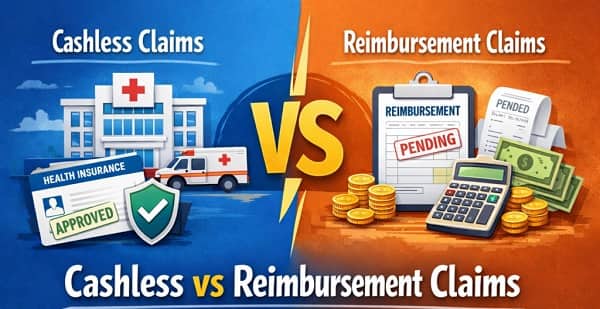
What is a Cashless Claim?
A cashless claim allows the insured person to receive treatment at a network hospital without paying the full medical bill upfront. The insurance company directly settles the eligible expenses with the hospital.
In this process, the patient only needs to pay for non-covered expenses such as registration charges, consumables, or excluded treatments.
How Does a Cashless Claim Work?
- Choose a network hospital listed by your insurer.
- Show your health insurance card and ID proof.
- Fill out the pre-authorization form.
- The hospital sends the documents to the insurer or TPA (Third-Party Administrator).
- After approval, treatment begins.
- The insurer directly pays the hospital for covered expenses.
Cashless claims are especially useful during emergencies because they reduce immediate financial pressure on the family.
What is a Reimbursement Claim?
In a reimbursement claim, the policyholder first pays the hospital bill from their own pocket. Later, the insured submits the required documents to the insurance company to recover eligible expenses.
This method is commonly used when treatment is taken at a non-network hospital or when cashless approval is unavailable.
How Does a Reimbursement Claim Work?
- Get treatment at any hospital.
- Pay the hospital expenses yourself.
- Collect all bills, reports, prescriptions, and discharge summaries.
- Submit the claim form and documents to the insurer.
- The insurer verifies the documents.
- Approved claim amount is transferred to your bank account.
Although reimbursement claims offer flexibility in hospital choice, they may involve more paperwork and waiting time.
Difference Between Cashless Claims and Reimbursement Claims
| Feature | Cashless Claim | Reimbursement Claim |
| Payment at Hospital | Insurer pays directly | Policyholder pays first |
| Hospital Requirement | Only network hospitals | Any hospital |
| Financial Burden | Low immediate burden | High upfront expense |
| Claim Process | Faster and smoother | More documentation |
| Approval Time | Usually quick | May take several days |
| Convenience | Highly convenient | Slightly time-consuming |
| Best For | Emergencies and planned treatments | Non-network hospital treatments |
| Paperwork | Minimal | Extensive |
Advantages of Cashless Claims
1. No Large Upfront Payment
The biggest advantage is financial relief during medical emergencies. Families do not need to arrange huge amounts instantly.
2. Faster Hospital Admission
Most network hospitals have dedicated insurance desks, making the process smoother.
3. Less Documentation
The hospital and insurer handle most formalities.
4. Better Peace of Mind
Patients can focus on recovery instead of arranging money.
Advantages of Reimbursement Claims
1. Freedom to Choose Any Hospital
You are not restricted to network hospitals.
2. Useful in Remote Areas
If network hospitals are unavailable nearby, reimbursement becomes practical.
3. Backup Option
Even if cashless approval is denied temporarily, you can still claim reimbursement later.
Disadvantages of Cashless Claims
- Available only at network hospitals.
- Some treatments may need prior approval.
- Non-medical expenses are not covered.
- Delays may occur if documents are incomplete.
Disadvantages of Reimbursement Claims
- Requires immediate out-of-pocket payment.
- Heavy paperwork and document management.
- Claim settlement may take longer.
- Partial rejection may occur if documents are missing.
Which is Better for You?
The answer depends on your medical needs, location, and financial situation.
Choose Cashless Claims If:
- You prefer convenience.
- You want financial relief during emergencies.
- You live near good network hospitals.
- You want a hassle-free hospitalization experience.
Choose Reimbursement Claims If:
- You want flexibility in choosing hospitals.
- You often travel to areas with limited network hospitals.
- You can manage temporary medical expenses.
For most people, cashless claims are generally more beneficial because they reduce financial stress during emergencies. However, reimbursement claims remain important as a backup facility.
Tips to Ensure Smooth Claim Settlement
For Cashless Claims
- Always check the insurer’s network hospital list.
- Inform the insurer within the required time.
- Carry policy documents and ID proof.
- Understand policy exclusions carefully.
For Reimbursement Claims
- Preserve every bill and receipt carefully.
- Submit documents within the deadline.
- Keep copies of all reports and prescriptions.
- Fill claim forms accurately.
Conclusion
Both cashless and reimbursement claims play an important role in health insurance. Cashless claims offer convenience and immediate financial relief, while reimbursement claims provide flexibility and broader hospital access.
Before buying health insurance, policyholders should check:
- Number of network hospitals
- Claim settlement ratio
- Claim process efficiency
- Waiting periods and exclusions
A well-informed decision can save both money and stress during medical emergencies.
FAQs
Q: Is cashless claim available in every hospital?
A: No. Cashless claims are available only at network hospitals associated with your insurer.
Q: Which claim process is faster?
A: Cashless claims are usually faster because the insurer directly settles the bill with the hospital.
Q: Can I use reimbursement if cashless is denied?
A: Yes. If your cashless request is denied, you can still file a reimbursement claim later.
Q: Do reimbursement claims require original bills?
A: Yes. Most insurers require original bills, prescriptions, and discharge summaries.
Q: Which option is better during emergencies?
A: Cashless claims are generally better during emergencies because they reduce immediate financial burden.
Q: Can partial expenses be rejected in both claim types?
A: Yes. Non-covered expenses and policy exclusions may be rejected in both cashless and reimbursement claims.
Q: What happens if treatment is taken at a non-network hospital?
A: You usually need to pay first and later apply for reimbursement.
